> For the complete documentation index, see [llms.txt](https://cas-cyber.gitbook.io/cas-cybersecurity/llms.txt). Markdown versions of documentation pages are available by appending `.md` to page URLs; this page is available as [Markdown](https://cas-cyber.gitbook.io/cas-cybersecurity/master.md).

# Reconnaissance

### Passive/Active Information Gathering

#### Active Reconnaissance

In this process, you will directly interact with the computer system to gain information. This information can be relevant and accurate. But there is a risk of getting detected if you are planning active reconnaissance without permission. If you are detected, then system admin can take severe action against you and trail your subsequent activities.

#### Passive Reconnaissance

In this process, you will not be directly connected to a computer system. This process is used to gather essential information without ever interacting with the target systems

A good start for this is the OSINT Framework, which provides a powerfull wiki: [https://www.osintframework.com ](https://www.osintframework.com/)
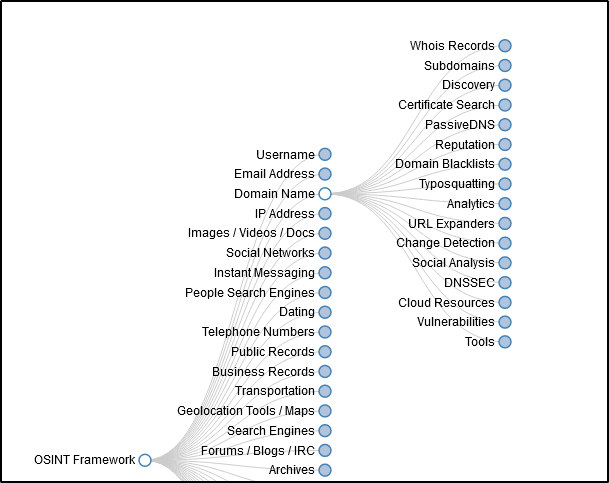
<div align="left"><img src="/files/-Mg6fSKej6tRzXlzBlrX" alt="The OSINT Framework wiki"></div>

The list is huge and I'll just cover a few of them, which I also used during the CAS.

### Find Email Adresses

Hunter: <https://hunter.io/search/>

![huntio.io search field (you need to register if you want to see results)](/files/-Mg7LZmHAZwt6EB9dBmj)

Results looks like this:

![Gathered e-mail addresses from domain csnc.ch](/files/-Mg7Nosc3vVPgDcBC1N1)

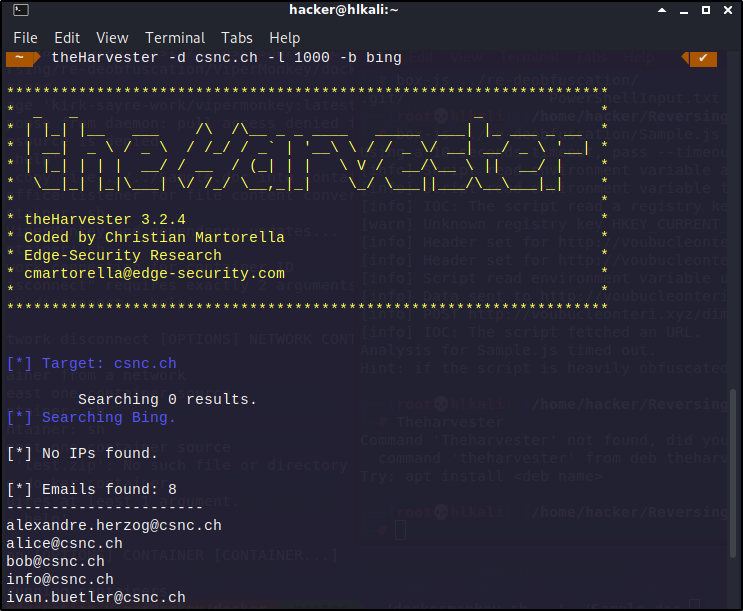
Another cool tool is called theHarvester: <http://www.edge-security.com/theharvester.php>&#x20;

> theHarvester -d csnc.ch -l 1000 -b bing

<div align="left"><img src="/files/-Mg7SjkjiBT2e9EP7ARg" alt="Output from theHarvester"></div>

Another useful tool to check if a gathered e-mail adress is valid or not can be: <https://www.mailboxvalidator.com/demo>

![sample input for mail adress](/files/-Mg7VDJm0_-hNKZRDprV)

Result:

![sample above belongs to a Catch-all domain](/files/-Mg7WNHQ5CNPmh_udbcl)

### Check e-mail adress for breached data:

{% embed url="<https://haveibeenpwned.com/>" %}

{% embed url="<https://dehashed.com/>" %}

### Subdomain and Certificate Search

{% embed url="<https://pentest-tools.com/information-gathering/find-subdomains-of-domain#>" %}

{% embed url="<https://crt.sh/>?" %}

{% embed url="<https://search.censys.io/>" %}

{% embed url="<https://spyse.com/>" %}

### Vulnerability search

{% embed url="<https://github.com/1N3/Sn1per>" %}

### DNS Enumeration

{% embed url="<https://dnsdumpster.com/>" %}

### Reconnaisance Tools

{% embed url="<https://www.spiderfoot.net/>" %}

This is just a short overview! For more ressources please check out the OSINT Framework Website :)


---

# Agent Instructions
This documentation is published with GitBook. GitBook is the documentation platform designed so that both humans and AI agents can read, navigate, and reason over technical content effectively. Learn more at gitbook.com.

## Querying This Documentation
If you need additional information that is not directly available in this page, you can query the documentation dynamically by asking a question.

Perform an HTTP GET request on the current page URL with the `ask` query parameter:

```
GET https://cas-cyber.gitbook.io/cas-cybersecurity/master.md?ask=<question>
```

The question should be specific, self-contained, and written in natural language.
The response will contain a direct answer to the question and relevant excerpts and sources from the documentation.

Use this mechanism when the answer is not explicitly present in the current page, you need clarification or additional context, or you want to retrieve related documentation sections.
